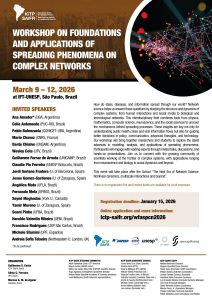
Workshop on Foundations and Applications of Spreading Phenomena on Complex Networks


March 9 – 12, 2026
IFT-UNESP, São Paulo, Brazil
Home
How do ideas, diseases, and information spread through our world? Network science helps us answer these questions by studying the structure and dynamics of complex systems, from human interactions and social media to biological and technological networks. This interdisciplinary field combines tools from physics, mathematics, computer science, neuroscience, and the social sciences to uncover the mechanisms behind spreading processes. These insights are key not only for understanding public health crises and viral information flows but also for guiding better decisions in policy, communication, advanced therapies, and technology. Our workshop will bring together researchers and students to explore the latest advances in modeling, analysis, and applications of spreading phenomena. Participants will engage with leading experts through invited talks, discussions, and hands-on presentations. Join us to connect with the growing community of scientists working at the frontier of complex systems, with applications ranging from neuroscience and biology to social dynamics and beyond.
This event will take place after the School “The Next Era of Network Science: Nonlinear dynamics, multiscale interactions and beyond“.
Organizers:
- Guilherme S. Costa (ICTP-SAIFR, Brazil)
- Silvio C. Ferreira (UFV, Brazil)
- Marcus A. M. de Aguiar (Unicamp, Brazil)
Announcement:
Application is now closed
Participants list here
Speakers
Speakers
- Ana Amador (Universidad de Buenos Aires, Argentina) – Emergent low-dimensional oscillatory dynamics in neural networks coding for birdsong
- Angélica Mata (UFLA, Brasil) – Complex Networks and Dynamical Systems: Perspectives on Applied Problems
- Celia Anteneodo (PUC-RIO, Brasil) – Opinion dynamics beyond pairwise interactions and binary choices
- Dante Chialvo (Universidad Nacional de San Martin, Argentina) – The brain at the edge
- Fernando Metz (UFRGS – Brasil) – Epidemic threshold of the SIS model on directed networks: a quenched mean-field analysis
- Francisco Rodrigues (USP – São Carlos, Brasil) – Modelling and predicting epidemics using networks and machine learning.
- Guilherme Ferraz de Arruda (UNICAMP, Brasil) – Contagion dynamics on higher-order networks
- Haroldo Valentin Ribeiro (UEM, Brasil) – Structure and dynamics of networked criminals
- Jesus Gomez-Gardenes (University of Zaragoza, Espanha) – The spread of Innovations and the accumulation of culture in networked populations
- Jordi Soriano Fradera (University of Barcelona, Espanha) – Activity Propagation, Connectivity, and Criticality in Neuronal Cultures
- Mario Chavez (CNRS, França) – Geometrical analysis of brain connectivity for seizure forecasting
- Michele Starnini (Universitat Pompeu Fabra, Espanha) – Ideological radicalization on social media: Echo-chambers, misinformation spreading, and platform migration
- Pablo Balenzuela (CONICET-UBA, Argentina) – Ideological Organization in Social Media Networks
- Seyed Moghadas (York University, Canadá) – Social Behaviour and Epidemic Dynamics: Risk, Imitation, and Homophily
- Suani Pinho (UFBA, Brasil) – Using Network Concepts and Data-Based Metapopulation Models of Infectious Diseases to Quantify Relevant Measures in Public Health
- Thomas Nogueira Vilches (UNESP – Botucatu, Brasil) – Mathematical epidemiology and control of hospital-associated infections
- Wesley Cota (UFV, Brasil) – Epidemic activation mechanisms in heterogeneous networks
Registration
Presentations
Short Talks
Monday (March 9)
- Chipicoski Gabrick, Enrique (State University of Ponta Grossa, Brazil): Climate-driven synchronization of dengue epidemics
In this work, we investigate the role of climate change in the synchronization of dengue fever outbreaks. Using epidemiological data from the state of Paraná, Brazil, we identify a geographical expansion of dengue into previously unexposed municipalities. By applying event synchronization analysis, we detect a systematic increase in the mean level of synchronization over time, indicating a growing temporal coherence among local outbreaks. This increasing synchronization is consistent with the expansion of dengue transmission into new regions. We further show that this pattern can be explained by an increase in the number of climate-suitable days, which enhances the environmental conditions for vector proliferation and disease transmission. Our findings highlight climate change as a key driver of the spatial expansion and synchronized dynamics of dengue epidemics.
- Gallegos Jiménez, Hernán Exequiel Einop (Universidad de Concepción, Chile): Analysis of Spatiotemporal Propagation of Wildfires in Chile using Complex Networks
Wildfires are destructive phenomena, both of natural and anthropic origin. Due to climate change and land mismanagement, wildfires are increasingly common and ignition more easily met and sustained, bringing loss in biodiversity, infrastructure, economical setbacks, and the loss of human life. Chile’s increasingly dry climate poses wildfires as a major risk every year. It is then vital to understand its underlying dynamics and their evolution over time. In particular, we propose that wildfires events over the last decades encode Chile’s fire regime and global behavior, propagation-wise. We use complex, spatial networks as the main theoretical framework. We use two decades worth of wildfire events database from CONAF, given spatial and temporal thresholds to ensure causality between events. The resulting networks per fire season are projected into a single weighted network, based on the frequency of correlations between unique locations across the record. By applying percolation algorithms on the networks, such as random and directed attacks, we will reveal relevant locations or hotspots in the registry, and give insight on the intensity of fire propagation from local to national scale. Ultimately, our results may damp economical, ecological and human life loss due to extreme wildfires. It may serve as a guideline to elaborate better and sharper prevention strategies in the public politics sphere, and give valuable insight during wildfire season, in order to prioritize resources and response time to locations known to be central on the network, with updated weights biased to the unique season’s climate conditions.
- Marenco, Ludwing (Future Technologies Development Center, Brazil): Unveiling Legislative Consensual Regimes: A novel approach with Extended Boltzman Machine and nearest Correlated Cluster Algorithm.
A new effective methodology for analyzing legislative systems is presented, built on two complementary approaches: an interactionist framework and a statistical framework. In the interactionist approach, a set of algorithms was developed to infer the interaction parameters of a spin-glass–like system. Using the Linear Response Approximation, both interaction and local fields can be obtained analytically. Additionally, an algorithm to estimate the system’s effective temperature based on the iterative scaling of the partition function is introduced for the first time. These procedures are integrated into what we term as the Extended Boltzmann Machine. In the statistical approach, we introduce a clustering algorithm based on maximizing correlation structure. The method employs a percolation-like process to compute the first and second giant components of a fully connected network. Clusters emerge by examining plateau regions of these giant components and can be visualized through the Minimal Spanning Tree (MST) ordered correlation matrix. This procedure is referred to as the Nearest Correlated Clusters Algorithm. We applied both approaches to publicly available roll-call vote data from three legislative lower houses: the United States House of Representatives, the United Kingdom House of Commons, and the Brazilian Chamber of Deputies. Using the political parties’ majority-opinion matrix within the interactionist framework, we identify consensual and dissensual legislative zones by comparing average party positions with the degree of political interaction at which transitions from dissensus to consensus occur. Conversely, by applying the statistical approach to individual legislators’ roll-call data, we identify consensual and dissensual legislative states. These states are characterized through the temporal evolution of MST-ordered correlation matrices and their associated probability distribution functions. Combining insights from both methodological layers allows us to propose legislative consensual regimes, offering a unified framework for understanding collective behavior in legislative systems. This methodology provides a powerful tool for deeply analyzing legislative dynamics and for anticipating emerging periods of political instability.
Tuesday (March 10)
- Marghoti, Gabriel (Departamento de Física da Universidade Federal do Paraná, Brazil): Signal Propagation in Spiking Neural Networks
Understanding how signals propagate through spiking neural networks is essential for linking network structure to function. In this work, we study signal propagation in networks of integrate-and-fire neurons and show that output spike trains can be systematically approximated from the network topology and incoming spike trains. By expanding the resulting expressions to include higher-order network neighborhoods, we derive an effective framework for describing how spiking activity propagates and is transformed across the network. This approach provides a tractable representation of network function based on signal processing principles and offers a unified view of structure-driven computation in spiking neural networks.
- Oliveira, Maria Vithória Peres Dias (São Carlos Institute of Physics(IFSC)/University of São Paulo(USP), Brazil): Influence of topological characteristics on the dynamics of neuronal networks
Neuronal networks’ dynamics depend on the connectivity structure, depicted in a connection matrix, as well as the dynamic representation of their activity. This matrix must follow Dale’s Law, distinguishing excitatory and inhibitory neurons and be sparse. Despite the extensive literature on dynamics in neuronal networks, the diversity of models used, with variations in terms of matrix density, respect for Dale’s Law, and the dynamic model of the neurons, makes it difficult to systematically compare the results. Topological characteristics like connection heterogeneity, modularity and degree assortativity are often ignored. This study aims to analyze topological impacts on network dynamics using a consistent model for comparability, based on numerical simulations to avoid analytical simplifications.
- Rodrigues Da Costa, Leonardo (Unicamp, Brazil): Motifs Synchronization for characterizing epilepsy
Epilepsy affects around 65 million people worldwide. One third of patients do not achieve seizure freedom with medication and a portion of these may require surgical intervention. Clinical diagnosis relies on the visual inspection of electroencephalogram (EEG) recordings to identify interictal epileptiform discharges (IEDs), a process that is time-consuming and subjective. This thesis introduces a computational method for IED analysis using Motif Synchronization (MS), a functional connectivity technique that constructs time-varying graphs (TVGs) from EEG data. The approach is computationally efficient and designed to reduce spurious connections from volume conduction. The methodology was applied to EEG data acquired during EEG-fMRI sessions from 75 individuals with epilepsy and three healthy controls, with an analysis performed on a sub-cohort of 10 patients with Mesial Temporal Lobe Epilepsy (MTLE). The study evaluated the impact of EEG referencing schemes, investigated the method’s ability to detect IEDs and localize the epileptogenic focus (EF), and explored the relationship between network topology and nonlinear signal properties. We also explored the feasibility of applying Motif Synchronization (MS) for seizure detection using standard clinical scalp EEG recordings from a subset of 261 patients in the Temple University Hospital Seizure dataset. Findings show that Common Median Referencing (CMR) provides the most accurate localization of IED-related activity. Aggregated Static Networks (ASNs), derived from TVGs, identified connected clusters corresponding to IED-generating regions in 9 out of 10 MTLE subjects and lateralized the epileptogenic hemisphere in 82.6% of the 75-patient cohort. Network connectivity metrics, especially the global clustering coefficient, were higher during IED segments compared to non-IED periods in the MTLE sub-cohort. A correlation was established between a node’s network strength and its nonlinear features, where network hubs exhibited high Statistical Complexity (SC) and low Permutation Entropy (PE). This study establishes MS as a tool for the detection and localization of epileptiform activity, while also offering a degree of clinical interpretability.
Thursday (March 12)
- Lorenzoni, Paulo Henrique (Universidade Federal de Viçosa (UFV), Brazil): Rare regions at an activation threshold model
Rare regions are characterized by the formation of domains that are weakly coupled by fluctuations. These domains persist for exponentially long times and lead to a non-universal power law decay of the order parameter, which is generally regarded as a hallmark of a Griffiths phase (GP). In general, the signature of a GP is a consequence of the introduction of quenched disorder. In the pure threshold model, i.e., without quenched disorder, a site becomes active if the number of active neighbors exceeds a given threshold. We investigated the threshold model on both random and regular graphs. When the threshold is equal to one, an inactive site requires at least one active neighbor to become active, recovering the dynamics of the Contact Process (CP). Depending on the threshold value, the system exhibits multistability and strong metastability effects. On regular lattices, for specific initial conditions, the model generates rare regions that lead to a non-universal power law decay. In contrast, when random regular graphs are considered, the GP signature disappears once small-world properties are present.
- Maia, Hugo Pereira (Federal University of Viçosa, Brazil): The Impacts of Nesting in Contagion Dynamics on Higher-Order Networks
In the context of network sciences, mechanisms of many-body interactions are referred to as higher-order networks. Phenomena absent from pairwise models, such as catastrophic activation, hysteresis, and hybrid transitions, emerge naturally in systems with sufficient higher-order effects [1]. Higher-order interactions on networks can be formulated as Simplicial Complexes (SC) or Hypergraphs (HG). While sometimes used interchangeably, SCs represent a special case where every higher-order interaction necessarily includes all its lower-order subsets. We employ a metric for the amount of lower-order interactions that are fully contained within hyperedges of larger sizes, referred to as nesting coefficients, with SCs and HGs having maximum and minimum nesting respectively. Through SIS simulations on both synthetic and empirical higher-order networks, we uncover a direct correlation between nesting and hysteresis loop length. Furthermore, empirical data were analyzed, revealing how scales and patterns of nesting are manifested for different orders in real higher-order networks. Our results provide guidelines for choosing the most appropriate formalism, highlighting distinct structural and dynamical features of SCs and HGs. Due to the increased complexity of many-body interactions, simulation of higher-order contagion dynamics in networks of sufficient sizes and desired heterogeneities is very computationally costly, therefore all simulations in this work were only possible with the use of optimized Gillespie algorithms that were proposed in a recent paper by the authors [2]. [1] F. Battiston, E. Amico, A. Barrat, G. Bianconi, G. Ferraz de Arruda, B. Franceschiello, I. Iacopini, S. Kéfi, V. Latora, Y. Moreno, et al., “The physics of higher-order interactions in complex systems,” Nature Physics, vol. 17, no. 10, pp. 1093–1098, 2021. [2] H. P. Maia, W. Cota, Y. Moreno, and S. C. Ferreira, “Efficient gillespie algorithms for spreading phenomena in large and heterogeneous higher-order networks,” arXiv preprint arXiv:2509.20174, 2025.
- Rommens, Cyril (University of Zaragoza, Spain): Information Theoretical Analysis of High Order Interactions in Social Contagion
Virus spreading dynamics can be modeled as continuous-time Markov chains. Within this framework, multivariate information measures can be calculated analytically, while the resulting dynamics generate discrete data for which probability estimation techniques are well established. This setting allows for an exact and systematic investigation of the capabilities and limitations of information-theoretic measures.
Posters
Monday (March 9)
- Antivar Gonzalez, Angie (Universidad Nacional de Colombia, Colombia): Epidemic phase transitions in an Adaptive SIS model on small-world networks
We study an adaptive Susceptible–Infected–Susceptible (SIS) model on a small-world network that incorporates behavioral responses through memory-based rewiring. Susceptible individuals modify their connections by reconnecting exclusively to previously known susceptible nodes, allowing the contact network to coevolve with the spreading process. Using Monte Carlo simulations, we explore how infection and reconnection rates affect epidemic prevalence, persistence, and phase transitions. Our results show that adaptive rewiring significantly shifts epidemic thresholds and stabilizes distinct healthy and endemic regimes, underscoring the importance of non-Markovian effects and network adaptation in spreading phenomena on complex systems.
- Brito Nascimento, Andrey (ICMC/UFSCAR/UEMASUL, Brazil): Rumor propagation in random dynamic graphs with group structure
naturally into the paragraph: In this work, we analyze rumor propagation in random dynamic graphs with community structure. We apply the methodology introduced by Clementi et al. (2008), which studies the evolution of the newly informed set over time. In particular, this approach allows us to track the growth of informed nodes and to estimate the flooding time of the rumor in dynamic networks with multiple communities. We then extend our results to the Degree-Corrected Stochastic Block Model (DCSBM), which incorporates node-specific degree parameters to adjust the connection probabilities and better capture degree heterogeneity
- Diaz Celauro, Lucas (Universidad de Buenos Aires, Facultad de Ciencias Exactas y Naturales, Argentina): Digital alignment in a billion-interaction analysis of political discourse across three US presidential elections (2016–2024)
In this work, we analyse over a billion Facebook interactions with content related to the last three U.S. presidential elections (2016, 2020, 2024). Combining two large-scale datasets (posts and ads), we use large language models to classify content into political topics, infer stance into binary categories, and reconstruct state-level patterns through a Bayesian integration framework. We address three main questions: (i) which issues dominated the online public agenda before each election, (ii) how topic- and stance-specific biases align with the political orientation of different regions, and (iii) how Donald Trump managed to capture the online public discourse in 2024. Across all elections, the Facebook agenda is highly concentrated in three top topics: Wokeness, Parties threaten democracy, and Economy absorb most of the engagement, with Immigration entering this core set precisely when Trump wins the elections. Engagement on these topics is systematically unbalanced and becomes more polarized over time, with strong anti-woke and anti-immigration biases that correlate tightly with short-term movements in Trump–Harris support on Facebook posts. In 2024, Trump’s speeches display clear temporal alignment with public reactions on Facebook, especially on Economy and Immigration, whereas Kamala Harris’ speeches show no comparable resonance. In 2020, it was Joe Biden who captured most of the engagement, particularly around Healthcare and National security. At the regional level, we find a robust alignment between stance patterns on issues such as Wokeness and Immigration and the popular vote difference across states, highlighting how specific issue framings and biases are intertwined with the political landscape.
- Dos Santos, Mariana Macedo (Universidade de São Paulo, Brazil): Higher-Order SIS Dynamics and Initial-Condition Dependence
Modeling contagion beyond pairwise contacts is key to capturing reinforcement effects in spreading dynamics. Here we investigate a discrete-time SIS process on networks with higher-order interactions and study how network structure and seeding conditions influence persistence and critical behavior. We compare dynamics across distinct topologies and connectivity heterogeneity, and examine how initial conditions can affect long-term prevalence when group-level reinforcement is present.
- Fernandes, Vinicius Narciso (Universidade Estadual Paulista – “Júlio de Mesquita Filho”, Brazil): Modeling mpox as a sexually transmitted infection
Mpox is a zoonotic viral disease caused by the MPXV virus, transmitted through close contact with lesions, respiratory droplets, bodily fluids, and contaminated materials, with sexual transmission being the most important route. The global outbreak of 2022–2023 showed a greater capacity for spread compared to previous outbreaks. The disease presents symptoms similar to smallpox, but generally milder, except in immunocompromised individuals, who may progress to hospitalization and death.This work aims to mathematically model the transmission of mpox in the human population, divided into two epidemiological groups (high and low), considering vaccination only in the high-risk group. The compartmental model includes susceptible, vaccinated, infected, and recovered individuals, as well as information, which influences group behavior regarding transmission and vaccination. Scenarios with and without vaccination were analyzed, in addition to cases in which virus transmission is restricted to only one of the groups. For each case studied, equilibrium points, thresholds for disease transmission or extinction, bifurcation diagrams, and the temporal evolution of the populations were calculated. The results show that vaccination, combined with other protective measures, reduces disease prevalence, and that information dissemination plays an important role in controlling virus transmission. Sensitivity analysis identifies which parameters are most sensitive and therefore have the greatest impact on disease dynamics.
- Perez Cosin, Sophia (UNESP – Universidade Estadual de São Paulo “Júlio de Mesquita Filho”, Brazil): Mathematical Analysis of an Epidemiological Model for the Transmission of Avian Influenza H5N1: Equilibrium Points, Stability and Sensitivity
Highly pathogenic avian influenza, viral subtype H5N1, is a highly contagious disease with multisystem clinical manifestations and is responsible for causing severe economic consequences for the international trade of poultry products. In this context, based on the biological aspects of disease transmission, classical compartmental models (SI and SIR) were constructed, and a system of ordinary differential equations was developed to describe the three populations involved in the disease dynamics: migratory birds, local wild birds, and poultry. The theoretical analysis includes the determination of equilibrium points and the study of their existence and local stability, as well as the calculation of the basic reproduction numbers associated with the complete model and its submodels, using the Next Generation Matrix method. Furthermore, through numerical simulations performed using the fourth-order Runge–Kutta method, bifurcation diagrams and the temporal evolution of the disease are presented, considering both intra- and intergroup interactions. In addition, a sensitivity analysis is carried out using the Partial Rank Correlation Coefficient (PRCC) in order to identify the most influential parameters on the identified epidemiological thresholds and to discuss disease control and containment strategies under different scenarios. Finally, graphs illustrating seasonal patterns and epidemiological maps depicting the geographical location and concentration of HPAI H5N1 cases in Brazilian territory, based on officially reported data, are presented, enabling the spatial visualization of disease distribution and the identification of regions at higher risk.
Tuesday (March 10)
- Gabaldon, Christopher (Departamento de Física, Facultad de Ciencias Exactas y Naturales , Universidad de Buenos Aires (UBA), Argentina): Heuristic inference of a complex system’s dynamical state
In the theory of critical phenomena, it is well known that the point of highest variability (and maximum susceptibility) identifies the system’s critical point. At the same time, graph theory recognizes that the percolation point can be detected through the divergence of a network’s diameter. In this work, we bring these ideas together with the aim of identifying the dynamical state of a system. We propose that the percolation point of the correlation matrix reflects this state. We evaluate this hypothesis in two synthetic systems with distinct dynamics: the Ising model, and a simple cellular automaton that captures the behavior of a set of excitable neurons. The results were reproduced using human fMRI data. In all cases, the critical point estimated through functional networks correlates linearly with the one inferred from other indicators, such as temporal autocorrelation measures. These findings are relevant for identifying the dynamical state of the brain in different subjects, both in healthy conditions (sleep, coma, etc.) and in disease (Alzheimer’s, Parkinson’s, etc.).
- Gonsalves, Paulo Henrique (State University of Ponta Grossa (UEPG), Brazil): Analysis of Spatial Patterns using Ordinal Networks
An important area of complex systems is the analysis of emerging patterns (whether in one, two, or more dimensions) resulting from the interaction between various agents or factors together. One of the tools for analyzing this type of pattern are techniques based on entropy and its derivatives, which allow us to analyze not only the evidence of regularity and randomness (permutation entropy) but also the existence (or not) of a priority among the possible configurations in a particular system. Based on these techniques, more specifically permutation entropy, we can “map” the patterns studied as ordinal networks and thus understand not only the possible neighborhood configurations in a system, but also the types of configurations to which the structures transition spatially. This work aims to show an alternative to the way in which certain two-dimensional patterns are analyzed and classified.
- Perez, Ignacio Augusto (Instituto de Investigaciones Físicas de Mar del Plata (UNMdP – CONICET), Argentina): Critical behavior of cascading failures in overloaded networks
While network abrupt breakdowns due to overloads and cascading failures have been studied extensively, the critical exponents and the universality class of such phase transitions have not been discussed. Here we study breakdowns triggered by failures of links and overloads in networks with a spatial characteristic link-length ζ. Our results indicate that this abrupt transition has features and critical exponents similar to those of interdependent networks, suggesting that both systems are in the same universality class. For weakly embedded systems (i.e., ζ of the order of the system size L) we observe a mixed-order transition, where the order parameter collapses following a long critical plateau. On the other hand, strongly embedded systems (i.e., ζ ≪ L) exhibit a pure first order transition, involving nucleation and growth of damage. The system’s critical behavior in both limits is similar to that observed in interdependent networks.
- Robalino Ramírez, Britney Carolina (Yachay Tech University, Ecuador): Information flow and the emergence of collective behavior in dynamical networks.
In this project we investigate the relationship between the emergence of collective behavior and the information flow between different scales of dynamical systems possessing global interactions. We consider global coupling functions whose source can be external (driven systems) or internal (autonomous systems). By employing general models of coupled chaotic maps for such systems, we shall study collective behaviors such as chimera states.
- Rodriguez Ornelas, Josue Mauricio (Universidad de Guadalajara, Centro Universitario de los Lagos., Mexico): Observability-Based Inference of Node Centrality in Networks of Nonlinear Oscillators
This research explores a novel methodology for extracting topological information from complex dynamical networks through the use of linear state observers. Specifically, it investigates how the estimation error generated by Luenberger-type observers—unidirectionally coupled to nonlinear oscillators—can reveal structural characteristics of the network, such as node centrality. The observers are implemented in a bilayer configuration, where each dynamical unit (e.g., Rössler oscillator) is paired with a dedicated observer receiving partial measurement signals. As a case study, the methodology is applied to star networks of increasing size, where one central node is connected to multiple peripheral nodes. Simulation results demonstrate a clear relationship between the estimation error and the node’s topological position: observers coupled to central nodes consistently exhibit larger errors than those linked to peripheral units, especially during partial synchronization regimes. This behavior reflects the greater complexity in estimating the state of highly connected nodes due to the accumulation of heterogeneous signals.
- Sulbaran Pineda, Hendrik Jose (Universidad Católica del Maule, Instituto Venezolano de Investigaciones Cientifícas (IVIC),, Chile): Effects of Colored Noise on Persistence and Invasion in a Discrete Predator–Prey Map
Discrete-time predator–prey models represent ecological interactions with non-overlapping generations, where changes in growth and interaction rates can drive transitions between extinction, persistence, and irregular fluctuations. Here we study the Maynard–Smith predator–prey map under variability in its deterministic control parameter, introduced as Ornstein–Uhlenbeck–type colored noise acting on growth/interaction intensity. Our objective is to quantify how noise intensity and correlation timescale affect predator persistence near the deterministic invasion (coexistence) threshold. We combine qualitative analysis of the deterministic map (as a baseline for regimes and transitions) with numerical experiments under temporally correlated stochastic forcing. Persistence is assessed using survival outcomes and extinction-time statistics from replicated simulations. We find that increasing noise intensity reduces predator persistence, and that the impact of temporal correlation becomes especially pronounced at moderate to high noise levels: in this range, a clear vulnerability window emerges at intermediate correlation timescales, where extinction risk is maximal. In contrast, under low-intensity noise the dynamics remain closer to the deterministic case and differences across correlation timescales are smaller. Overall, these results show that even in a minimal discrete predator–prey model, the temporal structure of environmental variability can strongly shape persistence outcomes, helping explain population collapses in correlated environments even when average conditions appear favorable.
Program
The schedule might be changed.
Videos and Files
-
09:00 - Jesus Gomez-Gardenes (University of Zaragoza):
The spread of Innovations and the accumulation of culture in networked populations
-
09:45 - Pablo Balenzuela (Universidad de Buenos Aires):
Ideological Organization in Social Media Networks
-
11:15 - Michele Starnini (Universitat Pompeu Fabra):
Ideological radicalization on social media: Echo-chambers, misinformation spreading, and platform migration.
-
14:00 - Enrique Chipicoski Gabrick, Hernán Exequiel Einop Gallegos Jiménez, Ludwing Marenco (State University of Ponta Grossa, Brazil, Universidad de Concepción, Chile, Future Technologies Development Center, Brazil):
Short talks 1
-
14:00 - Francisco Rodrigues (University of São Paulo):
Modelling and predicting epidemics using networks and machine learning
-
16:00 - Guilherme Ferraz de Arruda (UNICAMP):
Contagion dynamics on higher-order networks
-
09:00 - Suani Pinho (UFBA):
Using Network Concepts and Data-Based Metapopulation Models of Infectious Diseases to Quantify Relevant Measures in Public Health
-
09:45 - Seyed Moghadas (York University):
Social Behaviour and Epidemic Dynamics: Risk, Imitation, and Homophily
-
11:15 - Thomas Nogueira Vilches (Institute of Biosciences - UNESP):
Mathematical epidemiology and control of hospital-associated infections
-
14:00 - Angélica Mata (UFLA):
Complex Networks and Dynamical Systems: Perspectives on Applied Problems
-
14:45 - Haroldo Valentin Ribeiro (UEM):
Structure and dynamics of networked criminals
-
16:00 - Gabriel Marghoti, Leonardo Rodrigues da Costa, Maria Vithória Peres Dias Oliveira (UFPR, Brazil, Unicamp, Brazil, São Carlos Institute of Physics(IFSC)/University of São Paulo(USP), Brazil):
Short talks 2
-
09:00 - Dante Chialvo (Universidad Nacional de San Martin):
The brain at the edge
-
09:45 - Ana Amador (Universidad de Buenos Aires):
Emergent low-dimensional oscillatory dynamics in neural networks coding for birdsong
-
11:15 - Mario Chavez (Centre national de la recherche scientifique):
Geometrical analysis of brain connectivity for seizure forecasting
- 14:00 - Jordi Soriano Fradera (University of Barcelona): Activity Propagation, Connectivity, and Criticality in Neuronal Cultures
-
15:30 - Paulo Henrique Lorenzoni, Hugo Pereira Maia (Universidade Federal de Viçosa (UFV), Brazil, Federal University of Viçosa, Brazil):
Short talks -3
-
09:00 - Celia Anteneodo (PUC-RIO):
Opinion dynamics beyond pairwise interactions and binary choices
-
09:45 - Fernando Metz (UFRGS):
Epidemic threshold of the SIS model on directed networks: a quenched mean-field analysis
-
11:15 - Wesley Cota (UFV):
Epidemic activation mechanisms in heterogeneous networks
asdasdasd
Photos

Venue
Venue: The event will be held at IFT-UNESP, located at R. Jornalista Aloysio Biondi, 120 – Barra Funda, São Paulo. The easiest way to reach us is by subway or bus, See arrival instructions here.
Accommodation: Participants whose accommodation will be provided by the institute will stay at Hotel Intercity the Universe Paulista. Hotel recommendations are available here.
Attention! Some participants in ICTP-SAIFR activities have received email from fake travel agencies asking for credit card information. All communication with participants will be made by ICTP-SAIFR staff using an e-mail “@ictp-saifr.org”. We will not send any mailings about accommodation that require a credit card number or any sort of deposit. Also, if you are staying at Hotel Intercity the Universe Paulista, please confirm with the Uber/Taxi driver that the hotel is located at Rua Pamplona 83 in Bela Vista (and not in Jardim Etelvina).
Additional Information
BOARDING PASS: All participants, whose travel has been provided or will be reimbursed by ICTP-SAIFR, should bring the boarding pass upon registration. The return boarding pass (PDF, if online check-in, scan or picture, if physical) should be sent to secretary@ictp-saifr.org by e-mail.
Visa information: Nationals from several countries in Latin America and Europe are exempt from tourist visa. Nationals from Australia, Canada and USA are required to apply for a tourist visa.
Poster presentation: Participants who are presenting a poster MUST BRING A PRINTED BANNER . The banner size should be at most 1 m (width) x 1,5 m (length). We do not accept A4 or A3 paper.
Power outlets: The standard power outlet in Brazil is type N (two round pins + grounding pin). Some European devices are compatible with the Brazilian power outlets. US devices will require an adapter.
Security issues: Although São Paulo is a relatively safe city, be careful when using cellphones on the street, avoid isolated areas at night, and be aware when crossing the street that cars may not stop for pedestrians. Also, please do not leave valuable items like laptops unattended even for short breaks. At the IFT-UNESP, there are storage lockers available and keys can be obtained with our secretaries.