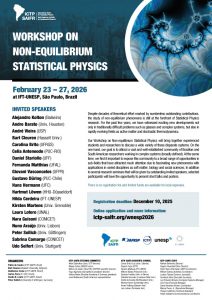
Workshop on Non-equilibrium Statistical Physics: From glasses and active matter to stochastic thermodynamics and complex networks


February 23 – 27, 2026
ICTP-SAIFR, São Paulo, Brazil
Venue: Principia Institute
Home
Despite decades of theoretical effort marked by numberless outstanding contributions, the study of non-equilibrium phenomena is still at the forefront of Statistical Physics research. For the past few years, we have witnessed exciting new developments not only in traditionally difficult problems such as glasses and complex systems, but also in rapidly evolving fields as active matter and stochastic thermodynamics.
Our Workshop on Non-equilibrium Statistical Physics will bring together experienced students and researchers to discuss a wide variety of these disparate systems. On the one hand, our goal is to attract a vast and well established community of Brazilian and South American researchers working in complex systems (broadly defined). At the same time, we find it important to expose this community to a broad range of opportunities in sub-fields that have attracted much attention due to fascinating new phenomena with applications in soft matter, biology and social sciences. In addition to several research seminars that will be given by outstanding invited speakers, selected participants will have the opportunity to present short talks and posters.
Organizers:
- Pablo de Castro (ICTP-SAIFR, Brazil)
- Bart Cleuren (Hasselt University, Belgium)
- Guilherme Costa (ICTP-SAIFR, Brazil)
- Carlos Fiore (IF-USP, Brazil)
- Danilo B. Liarte (ICTP-SAIFR, Brazil)
- Peter Sollich (University of Göttingen, Germany)
Announcement:
Application is now closed
List of participants here.
Speakers
Speakers
- Alejandro Kolton (Balseiro, Argentina) – When Driven Interfaces Go Wild: Chaos and Roughening Without Disorder
- Alexandre Morin (Leiden University, Netherlands) – Control of collective activity to crystallize an oscillator gas
- Andre Barato (Univ. Houston, USA) – Second law for active heat engines
- André Vieira (USP, Brazil) – Results on phase transitions in nonequilibrium systems in contact with two thermal reservoirs
- Bart Cleuren (Hasselt University, Belgium) – Resetting Beyond Position
- Carolina Brito (UFRGS, Brazil) – Wetting, Metastability, and Active Probes
- Celia Anteneodo (PUC-RIO, Brazil) – Critical patch size in population dynamics
- Daniel Stariolo (UFF, Brazil) – Dynamics of disordered systems with non-reciprocal interactions
- Fernanda Matias (UFAL, Brazil) – Characterizing brain signals across different cortical states using symbolic methodology, permutation entropy, and statistical complexity
- Giovani Vasconcelos (UFPR, Brazil) – Statistical Mechanics of Hierarchical Complex Systems (H Theory)
- Gustavo Düring (PUC-Chile, Chile) – Active Solids: Orientation Selection in Collective Motion and Active Waves
- Hans Herrmann (UFC, Brazil) – Multiple Percolating Clusters
- Hartmut Löwen (HHU-Düsseldorf, Germany) – Complex clusters and networks in active matter
- Hilda Cerdeira (IFT-UNESP, Brazil) – Topological transitions in a system of swarmalators
- Kirsten Martens (Univ. Grenoble, France) – Disorder-induced stress-flow misalignment in soft glassy materials revealed using multi-directional shear
- Laura Lotero (Universidad Nacional de Colombia) – Human flows in cities: A network analysis of urban mobility
- Nara Guisoni (CONICET, Argentina) – Stochastic models and mean-field equations: the power of a synergistic approach in ecology
- Nuno Araújo (Univ. Lisbon, Portugal) – Conformal Invariance and Criticality in Active Flows: Geometry, Topology, and Non-Equilibrium Phase Transitions
- Peter Sollich (Univ. Göttingen, Germany) – Barrier crossing and rare fluctuations of active particles
- Sabrina Camargo (CONICET, Argentina) – Correlation-Based Control of Excitable Dynamics Near Bifurcation Points
- Udo Seifert (Univ. Stuttgart, Germany) – Entropy production and its model-free inference
Registration
Program
Presentations
Short Talks
Monday (February 23)
- Bakaev, Artur (Freie Universitaet Berlin, Germany): Modeling active motion interactions in hydrogels via data-driven non-Markovian coarse graining
Understanding the motility of living cells in their natural hydrogel-like environments is a central challenge across disciplines ranging from biomedical science to soft-matter physics. Using the Generalized Langevin Equation, which is an exact framework for active and passive motion that can be derived from an underlying many-body Hamiltonian, we model both the viscoelastic properties of hydrogels and the dynamics of organisms far from thermodynamic equilibrium. This coarse-grained, data-driven approach provides a non-destructive way to infer organisms’ interactions with their environment. It enables the prediction of long-time diffusivities, the study of collective behavior in active systems, and the characterization of interactions within mucin-rich hydrogels, which is relevant for current investigations of pathogen mobility in animal and human hosts. Beyond motility properties, our framework can be readily extended to a wide range of experimental time-series datasets.
- Carranco-Sapiéns, Gabriel Alfonso (Instituto de Física – Universidad Nacional Autónoma de México, Mexico): GIANT DENSITY FLUCTUATIONS IN A ONE DIMENSIONAL ACTIVE PARTICLE SYSTEM WITH THERMAL NOISE
An \textit{active particle} is capable of cyclic and systematic dissipation of local energy into persistent movement. Because of this, matter composed of active particles (\textit{active matter}) exhibits stationary states that are inherently out of thermodynamic equilibrium. Such states present emergent properties like the appearance of \textit{giant number} or \textit{giant density fluctuations}. In general, the number of particles in an open subsystem of a simple system experiences fluctuations, even in thermodynamic equilibrium. Such fluctuations may be quantified for that subsystem observing that its mean particle number $\langle N \rangle$ and its standard deviation $\Delta N$ generally satisfy a power law of the form $\Delta N \propto \langle N \rangle^\varepsilon$, where $\varepsilon > 0$. In the case that such a subsystem also has a constant volume, the behavior of the number and density fluctuations is the same. We say that a system experiences \textit{giant fluctuations} when the exponent from the power law is greater than value usually found in equilibrium, $\varepsilon = \frac{1}{2}$. In this work we present a computational analysis of the number fluctuations of a one-dimensional system of \textit{run-and-tumble} active particles in the stationary regime. Such particles are pointlike and impenetrable, subject to a thermal bath of constant temperature, confined within a box of fixed length, and noninteracting in any other manner. We found that the number fluctuations exponent is well defined and is a continuous function of two parameters: the system density and the ratio defined by the diffusion coefficient of the particles in the fluid and the equivalent active diffusion coefficient. The global minimum and maximum obtained for a system of $2000$ particles were $0.447(4)$ and $0.849(2)$, respectively. This means that some regions of the parameter space display giant number or density fluctuations, comparable to other active matter systems and equilibrium critical point fluctuations despite the spatial dimension of the system and the lack of velocity-alignment interactions. We confirmed that the systems with the highest fluctuations at a fixed density are those that lack thermal effects, and that the exponent increases with density. Additionally, we found a second maximum of the exponent for dense systems when thermal effects are present. The exponent of the second maximum also increases with the density, although it requires higher activities according to a power law.
- Carreras Oropesa, William Gabriel (ICTP-SAIFR, Brazil): Transport Properties of Active Particles Moving on Adjustable Networks
Active adaptive matter has attracted growing interest due to its rich and still largely unexplained dynamics, as well as its relevance to a wide range of synthetic and biological systems. A particularly intriguing subclass comprises active particles that are able to remodel the networks on which they move. Here, we introduce a minimal yet versatile model of active particles evolving on an adaptive network. In our model, particles perform discrete run-and-tumble dynamics along the links of a triangular lattice, leaving behind trails of temporarily blocked links. These blocked links cannot be traversed by other particles and reopen only after a characteristic healing time. This trail-mediated blocking mechanism is fundamentally different from more familiar interactions such as steric (excluded-volume) effects. In the high-persistence regime, we uncover a striking qualitative contrast between the two mechanisms: whereas steric blocking suppresses particle diffusivity as persistence increases, trail-induced blocking leads to a monotonic enhancement of diffusivity. We characterize this unexpected transport behavior, elucidate its underlying mechanism, and discuss potential implications for active transport in adaptive environments.
- De Souza, Lucas (Federal University of Rio Grande do Norte, Brazil): How quorum sensing shapes clustering in active matter
Active matter refers to nonequilibrium systems composed of a large assembly of self-propelled entities, such as bacteria, tissue cells, animal flocks, and colloids. A common trait among them is collective behavior, arising from interactions between individuals. One communication strategy between microorganisms is chemically sensing others’ presence, a mechanism known as quorum sensing [1]. This mechanism induces a response in which the organisms regulate their movement to achieve ecologically favorable spatial distributions. However, motion can be limited by excluded-volume interactions. When self-propulsion directions fluctuate slowly, the combination of persistent motion and excluded volume can lead to particle clustering [2]. Quorum-sensing regulation may then alter this scenario, generating diverse spatiotemporal patterns [3,4]. We show that active particles with steric repulsion and quorum-sensing motility reduction display reentrant clustering. As control parameters are varied, clustering disappears and then reappears. One of the phase behaviors that emerges from this interplay is a previously unexplored class of active gels induced by quorum sensing. While quorum sensing can mimic attraction, it also produces strong effects in dilute regions, leading to distinct phase behavior. Remarkably, quorum sensing leads to kinetically-arrested transient states with long memory of the system’s initial condition. We then present a quorum-sensing kinetic theory that captures these phenomena. These results can link phenomena in synthetic and biological systems and show how the combination of excluded volume and quorum sensing can yield a variety of self-organization phenomena. [1] M. B. Miller et al. Annu. Rev. Microbiol. 55, 165-199 (2001). [2] J. Palacci, et al. Science 339, 936–940 (2013). [3] A. I. Curatolo, et al. Nat. Phys. 16, 1152 (2020). [4] T. Lefranc et al. Phys. Rev. X 15 (2025).
- Teixeira, Emanuel Fortes (Leiden University, Netherlands): Cell segregation with active contractile membranes
Cell cortex contraction is essential for cellular morphogenesis, enabling critical processes such as motility, division, and responding to mechanical signals— functions fundamental to multicellular systems. While existing simulations of cell segregation have successfully captured mechanisms like differential adhesion and velocity variations, traditional modeling approaches (e.g., Vertex models, Potts models, or finite difference methods) remain limited by their inability to distinguish membrane tension from intercellular adhesion effects. Consequently, these frameworks cannot demonstrate the potential role of differential cortical contraction in driving segregation. Here, we introduce an active-particle ring model where intercellular interactions are mediated by differential contraction. We demonstrate that this mechanism alone can induce segregation, with the activity of rings serving as an effective temperature-like parameter.
Tuesday (February 24)
- Amari, Aude (Roskilde University, Denmark): Material time in large temperature up-jump simulations
Physical ageing is a highly non-linear process which indicates gradual modifications in the properties of a system over time due to rearrangement of its particles. The Tool-Narayanaswamy formalism suggests a way to extend the range of applicability of linear response theory by introducing the so-called material time, an internal clock whose ticking rate changes as the system ages [1, 2, 3]. Can this global material time always be defined, especially in the presence of large dynamical heterogeneities? Is it the same for all ageing quantities? Is it a global or a local clock? We investigate these questions by simulating the physical ageing of a binary Lennard-Jones glass-forming liquid following large temperature up-jumps from equilibrated low-temperature states. [1] Narayanaswamy, O.S. (1971), A Model of Structural Relaxation in Glass. Journal of the American Ceramic Society 54, 491-498. [2] Riechers B., Roed L.A., Mehri S., et al. (2022) Predicting nonlinear physical aging of glasses from equilibrium relaxation via the material time. Sci. Adv. 8,eabl9809. [3] Böhmer, T., Gabriel, J.P., Costigliola, L. et al. (2024) Time reversibility during the ageing of materials. Nat. Phys. 20, 637–645.
- Bagchi, Sudipto (Indian institute of technology Kharagpur, India): Emergent Glassy Behavior of Chemotactic Active Particles in Fluid Flows
Microorganisms interact and communicate through physical and chemical processes to regulate growth, movement and biochemical activities. Chemotaxis refers to the directed movement of microorganisms by sensing ambient chemical gradients. We consider a minimal model to describe a collection of chemotactic, active and interacting Brownian particles in two-dimensional model cellular and turbulent flows. We expect these traits, in general, to be useful for microorganisms. Active glassy transition is well-studied in dense active matter systems. In prior studies, the glassy transition has been controlled by a higher packing fraction and other parameters like high persistent time. The interplay of the underlying fluid flow, activity, and chemotactic sensing can give rise to emergent high local packing fraction zones, which mediate glassy transition even in low packing fraction, which has been one of the key features of this study. The dynamical slowdown of the particle with growing chemotactic sensitivity explains the liquid-glass transition. Moreover, the characterization of transport properties suggests the presence of sub-diffusive phases in the system. The large relaxation timescale in this regime showed the high relaxation of the glassy dynamics obeying the features of a glassy phase. Our results offer insights into the complex collective behavior of microorganisms, such as bacteria, in fluid environments and suggest that high chemical sensitivity can lead to an arrested, glass-like state.
- Escobar Agudelo, Jorge Mario (UNESP-IFT, Brazil): Effective-medium theory for elastic systems with correlated disorder
Correlated structures are intimately connected to intriguing phenomena exhibited by a variety of disordered systems such as soft colloidal gels, bio-polymer networks and colloidal suspensions near a shear jamming transition. The universal critical behavior of these systems near the onset of rigidity is often described by traditional approaches as the coherent potential approximation – a versatile version of effective-medium theory that nevertheless have hitherto lacked key ingredients to describe disorder spatial correlations. Here we propose a multi-purpose generalization of the coherent potential approximation to describe the mechanical behavior of elastic networks with spatially-correlated disorder. We apply our theory to a simple rigidity-percolation model for colloidal gels and study the effects of correlations in both the critical point and the overall scaling behavior. We find that although the presence of spatial correlations (mimicking attractive interactions of gels) shifts the critical packing fraction to lower values, suggesting sub-isostatic behavior, the critical coordination number of the associated network remains isostatic. More importantly, we discuss how our theory can be employed to describe a large variety of systems with spatially-correlated disorder.
- Das, Debankur (University of Goettingen, Germany): Magnus forces in Non markovian fluid
pinning objects moving through air or liquids experience a Magnus force, a phenomenon widely exploited in ball sports and significant in various scientific and engineering applications.Opposed to large objects where Magnus forces are strong, they are only weak at small scales and eventually vanish for overdamped micron-sized particles in simple liquids. Here we demonstrate an about one-million-fold enhanced Magnus force of spinning colloids in viscoelastic fluids. Such fluids are characterized by a time-delayed response to external perturbations which causes a deformation of the fluidic network around the moving particle. We further develop a general theory for externally spinning particles in a non-Markovian bath. Without any applied force, the interplay between rotation and stochastic noise-induced local deformations leads to enhanced diffusion. Our theory also uncovers that for a spinning particle, orthogonal displacement components are correlated. These correlations are non-local in time and exhibit properties akin to the Magnus deflection. We present experimental evidence supporting these non-trivial phenomena in viscoelastic fluids. Our model predictions have broad implications for understanding the dynamics of particles in non-Markovian baths with memory effects, applicable to systems ranging from biological cells to synthetic colloids.
- Kent-Dobias, Jaron (ICTP-SAIFR, Brazil): Very persistent random walkers reveal transitions in landscape topology
In large random systems, certain behaviors are reliably predicted, like the energy density of the ground state. The long-time behavior of many physical and algorithmic dynamics is likewise predictable, through DMFT and related approaches. But can these behaviors be connected to static structures of the problem at hand, like its energy landscape? Recently, development of the Overlap Gap Property, which depends on the existence of a system-spanning component of the energy level set, suggests that static topological properties can predict the performance of the best algorithms. Here, I will describe progress towards predicting the performance of the mediocre but simple algorithms we usually use. We use the ergodicity of a random walker to probe whether typical configurations belong to a system-spanning component of the energy level set. Passive random walkers lose ergodicity at a depth associated with the glass transition, but active random walkers remain ergodic to greater depth. We argue that in the limit of infinite persistence time, the ergodicity-breaking transition coincides with the point at which system-spanning components become atypical, and discuss connections with gradient descent dynamics.
- Leiva Relmucao, Leonardo (Pontificia Universidad Católica, Chile): Bridging the Gap Between Avalanche Relaxation and Yielding Rheology
The yielding transition in amorphous materials, whether driven passively (simple shear) or actively, remains a fundamental open question in soft matter physics. While avalanche statistics at the critical point have been extensively studied, the emergence of the dynamic regime at yielding and the steady-state flow properties remain poorly understood. In particular, the significant variability observed in flow curves across different systems lacks a clear explanation. We determine, for the first time, the relationship between avalanche duration and size across the yielding transition, revealing how it evolves from quasistatic to dynamic flow regimes. This precise measurement is made using the Controlled Relaxation Time Model (CRTM), a new simulation framework that treats the relaxation time as a tunable parameter. CRTM reproduces known results in both limits and enables a direct analysis of the change of regime between them. Applying the model to different microscopic dynamics, we find that the existing scaling relation connecting critical exponents under flow holds for passive systems. However, active systems exhibit significant deviations, suggesting a missing ingredient in the current understanding of yielding.
Wednesday (February 25)
- Harunari, Pedro Eduardo (Aix Marseille University, France): Thermodynamic limits of communication channels
Life and technology alike thrive on the efficient transmission of information through channels, enabling organisms to adapt and machines to compute. Yet, communication incurs a cost that is constrained by finite energy budgets and poorly understood. We explore the interplay between information-theoretic and thermodynamic quantities, revealing that the quality of any channel is limited by its energy dissipation. The main concepts and results are illustrated in three pedagogically chosen examples from distinct disciplines: a binary symmetric channel, a model for cell sensing, and the CMOS inverter.
- Batista, Adriano (Universidade Federal de Campina Grande, Brazil): Deep noise squeezing in parametrically driven resonators with and whithout feedback
Here we investigate squeezing of fluctuations in the frequency domain of classical parametrically-driven resonators with additive white noise [1]. We analyze the resonators’ response to noise using Green’s functions. In one approach, we obtain the Green’s function approximately using the first-order averaging method or the harmonic balance method, while in the second approach, exactly, using Floquet theory. We characterize the noise squeezing by calculating the statistical properties of the real and imaginary parts of the Fourier transform of the resonators response to added noise. We applied our general techniques to investigate squeezing in a dynamical system consisting of a parametric resonator coupled linearly to a harmonic resonator. In this system, we observed deep squeezing at around -40 dB in one of the quadratures of the harmonic resonator response. We noticed that this occurs near a Hopf bifurcation to parametric instability, which is only possible when the dynamics of the coupled resonators cannot be decomposed into normal modes. We point out that our analysis of squeezing based on Floquet theory can be applied to multiple coupled resonators with parametric modulation and multiple noise inputs. Furthermore, we demonstrate how this theoretical framework can account for feedback in a single parametric resonator to achieve deep squeezing or cooling [2]. The methods developed here could be applied to investigate the response of phase states of Josephson (or Kerr) parametric oscillators to noise, a topic of relevance to qubit stabilization and the mitigation of phase-flip error [3]. [1] A. A. Batista, R. S. Moreira, and A. L. de Souza, Physica A , 130603 (2025). [2] A. A. Batista, arXiv:2501.06991 (2025), 10.48550/arXiv.2501.06991. [3] A. Grimm et al., Nature v. 584, 205–209 (2020)
- Medel, Hector (Tecnologico de Monterrey, Mexico): Geometry-driven non-equilibrium phase transition in hard-sphere gas on 1-D elliptic curves
In this work we present a qualitative analysis of a non-equilibrium phase transition in hard-sphere gases confined on elliptic curves, where intrinsic geometry curvature drives spontaneous clustering. Using an exact symplectic integration we could reach a good relative energy conservation that allowed us to study the dynamics of clustering. We found a ranges of parameters where cluster follows deterministic and stochastic nucleation without the indication of thermodynamic criticality. Despite of energy conservation the system follows a not thermalized behavior in the domain of time we studied. The phenomenon resembles motility-induced phase separation in active matter but clearly arises from purely geometric conditions.
- Ortiz Ambriz, Antonio (Tecnológico de Monterrey, Mexico): Artificial colloidal ice with anisotropic interactions: spin freezing and diffusionless transformations
Artificial Colloidal Ice is a model system for geometric frustration, which has the advantage that its dynamics are accessible on experimental time and length scales. It consists of magnetic colloids placed inside bistable potentials, realized by lithographically etching grooves into a substrate. The superparamagnetic colloids can be made to interact by applying an external magnetic field, usually perpendicular to the surface, which makes them repulsive. Using numerical simulations, we find that if the rotational symmetry of the interactions is broken by tilting the field, the system presents many interesting phenomena. When quenching at finite times, the particles freeze in disordered configurations, even in the absence of quenched disorder in the underlying substrate. On the other hand, when starting from an ordered state with repulsive interactions, the rotation of the field induces a diffusionless, martensite-like transformation, which, interestingly, falls into ordered states only at fast transition rates, but becomes disordered if the transition is carried out slowly enough.
- Mamani Arce, Yhony (Institute of Theoretical Physics – UNESP, Brazil): Active Swimmers in Smectic-A: Planar and Focal Conic Configurations
Self-propelled swimmers exhibit fascinating dynamic behaviors when navigating complex fluids, with relevance to systems ranging from biological microswimmers to synthetic active matter. While previous studies have shown that smectic layer fluctuations can lead to anomalous dynamics [Ferreiro2018], the interplay between activity and static smectic microstructures remains less explored. Here we investigate the motion of Active Brownian Particles (ABPs) embedded in two classes of director configurations. We start with the ground state of the smectic liquid crystal: a planar geometry in which all layers are perfectly flat. We derive an analytical solution for the effective motion that reveals a non-trivial dependence on the Péclet number and the coupling term representing the interaction between the active particle and the liquid crystal. These analytical results are corroborated by simulations, which perfectly capture the ballistic dynamics. Additionally, we extend our numerical approach to investigate the dynamics of an ABP swimming in focal conic domains, showing how complex geometrical defects influence active transport.
- Timpanaro, André (CMCC – UFABC, Brazil): Emergence of opinion splits in the Sznajd model with latency
In the modelling of social systems, opinion latency is the idea that once an agent changes its opinion, there will be a period of time where it is immune to other changes. When added to the voter model this leads to a situation where no matter how low the latency is or how many opinions are considered, all opinions end up in a coexistence where they are equally represented. In this work, we examine what happens when latency is added to the Sznajd model. What we find is that for low latency, the model behaves roughly like it does in the absence of latency, where one opinion will always eventually dominate. For high latency, the possibility for a symmetric coexistence of 2 opinions arises, but contrary to the voter model, a coexistence of more than 2 opinions is not stable. We provide evidence of this phenomenon with computer simulations of the model in Barabási-Albert networks, together with a mean field treatment that is able to capture the observed behavior.
Thursday (February 25)
- Forão, Gustavo (Universidade de São Paulo, Brazil): Optimal Control Strategy for Collisional Brownian Engines
Collisional Brownian engines have recently gained attention as alternatives to conventional nanoscale engines. However, a comprehensive optimization of their performance, which could serve as a benchmark for future engine designs, is still lacking. In this work, we build upon this by deriving and analyzing the optimal control strategy for a collisional Brownian engine. By maximizing the average output work, we show that the optimal strategy consists of linear force segments separated by impulsive delta-like kicks that instantaneously reverse the particle’s velocity. This structure enforces constant velocity within each stroke, enabling fully analytical expressions for optimal output power, efficiency, and entropy production. Remarkably, when evaluated using realistic experimental parameters, the efficiency approaches near unity at the power optimum, with entropy production remaining well controlled. To analyze a more realistic scenario, we examine the impact of smoothing the delta-like forces by introducing a finite duration and find that, although this reduces efficiency and increases entropy production, the optimal strategy still delivers high power output in a robust manner.
- Gupta, Deepak (Technical University of Berlin, Germany): Inference of a time delay in stochastic systems
Time delay plays a crucial role in many real-world systems and laboratory experiments. It can arise naturally (e.g., due to finite reaction times) or be intentionally introduced (e.g., for chaos control). A key challenge in theoretical modeling and data analysis is determining whether a time delay is present, in what form it appears, and how it influences the system’s dynamics. This involves detecting its presence, characterizing and quantifying its effects, and estimating the delay time. Here, we focus on overdamped stochastic systems and investigate time delay introduced through linear and nonlinear time-delayed feedback forces that depend on a discrete delay time. Such feedback can significantly influence transport properties or give rise to unusual dynamical behaviors, including persistent motion [1] and emergent collective phenomena [2]. By analyzing the power spectral density (PSD), we find that certain features characteristic of analytically tractable linear systems persist in the PSDs of specific nonlinear systems, enabling the inference of time delay. Moreover, even when only a few short temporal trajectories are available, a probing approach combined with deep neural network techniques can successfully infer the delay time from stochastic trajectories [3]. References: [1] R. A. Kopp and S. H. L. Klapp, Persistent motion of a Brownian particle subject to repulsive feedback with time delay, Phys. Rev. E 107 (2023) 024611. [2] R. A. Kopp and S. H. L. Klapp, Spontaneous velocity alignment of Brownian particles with feedback-induced propulsion, EPL 143 (2023) 17002. [3] R. A. Kopp, S. H. L. Klapp, and D. Gupta, Inference of a time delay in stochastic systems, arXiv:2507.10429 (2025).
- Mamede, Iago (IFUSP, Brazil): Work statistics at first-passage times
We investigate the work fluctuations in an overdamped non-equilibrium process that is stopped at a stochastic time. The latter is characterized by a first passage event that marks the completion of the non-equilibrium process. In particular, we consider a particle diffusing in one dimension in the presence of a time-dependent potential $U(x,t) = k |x-vt|^n/n$, where $k>0$ is the stiffness and $n>0$ is the order of the potential. Moreover, the particle is confined between two absorbing walls, located at $L_{\pm}(t) $, that move with a constant velocity $v$ and are initially located at $L_{\pm}(0) = \pm L$. As soon as the particle reaches any of the boundaries, the process is said to be completed and here, we compute the work done $W$ by the particle in the modulated trap upto this random time. Employing the Feynman-Kac path integral approach, we find that the typical values of the work scale with $L$ with a crucial dependence on the order $n$. While for $n>1$, we show that $\mom{W} \sim L^{1-n}~\exp \left[ \left( {k L^{n}}/{n}-v L \right)/D \right] $ for large $L$, we get an algebraic scaling of the form $\mom{W} \sim L^n$ for the $n<1$ case. The marginal case of $n=1$ is exactly solvable and our analysis unravels three distinct scaling behaviours: (i) $\mom{W} \sim L$ for $v>k$, (ii) $\mom{W} \sim L^2$ for $v=k$ and (iii) $\mom{W} \sim \exp\left[{-(v-k)L}\right]$ for $v
- Silva Filho, Fernando Francisco (IF USP, Brazil): Thermodynamics of frustrated Ising model under non conservative drivings
Geometrically frustrated systems with Ising-like interactions exhibit a richness of behaviors and present applications in the realm of classical and quantum phase transitions. However, a systematic study of such configurations under the action of non-equilibrium variables is still lacking. In this talk, we intend to present the generalization of the minimal model for a triangular lattice far from equilibrium, composed of three sublattices that interact simultaneously with two reservoirs in the presence of non-conservative drivings. We focus our attention on two main possible configurations: the ferromagnetic and the antiferromagnetic interactions in the all-to-all scenario. Its ferromagnetic description exhibits remarkable features, such as the existence of two ordered phases meaningfully different from each other, characterized by a discontinuous phase transition and a crossover connected by a critical point. The point of the discontinuous transition depends on which phase initially dominates, which is a signature of non-equilibrium phase transitions in spin lattices under the presence of externally biased drivings. The antiferromagnetic version presents similar features, with the two ordered states split by first and second order phase transitions according to the strength of the external driving and the temperature gradient, with the transitions connected by a tricritical point. Using stochastic thermodynamics, we also investigate the entropy production, which captures the discontinuity and also the critical behavior of the system, while reproducing the irreversible character and the dissipation of the whole system.
- Talbi, Khalid (Faculty of Applied Sciences Ait Melloul, Morocco): Thermodynamic Witnessing of Quantum Correlations in Non-equilibrium Light–Matter Systems
Non-equilibrium processes provide a fertile ground for exploring the interplay between information, energy, and quantum correlations. In this work, we investigate how extractable work can serve as a thermodynamic witness of entanglement in a nondegenerate three-level laser operating far from equilibrium. By modeling the laser modes as a two-mode Gaussian state coupled to a shared thermal reservoir, we establish an operational criterion that directly links the extractable work from a Szilard-like engine to the presence of quantum correlations. Our analysis demonstrates that this criterion vanishes for separable states, increases with atomic coherence, and reproduces the predictions of conventional measures such as logarithmic negativity. The results highlight a tangible connection between quantum thermodynamics and non-equilibrium statistical physics, suggesting new experimental pathways for probing entanglement in driven-dissipative light–matter systems.
- Pires, Luis Barbosa (Universidade Federal de Viçosa, Brazil): Dynamics of gallium-indium microparticles in an optical tweezer
We investigate the nonequilibrium dynamics of eutectic gallium–indium (EGaIn) microparticles optically trapped with a tightly focused gaussian 1064 nm laser. By characterizing their trajectories and probability currents, we identify signatures of nonequilibrium steady states relevant to stochastic thermodynamics. The results establish EGaIn microparticles as a promising platform for implementing autonomous microscopic heat engines and exploring thermodynamic behavior in optically driven metallic systems.
Posters
- Arts, Mattheus (Instituto de Física Gleb Wataghin, Brazil): Stochastic Entropy Production in the Classical Drude Model
The possibility of a negative entropy production rate in the Drude model, hinted at in recent literature, is investigated by treating it as an underdamped system. We derive the entropy production rate analytically through both phase space path integrals and Kramers equation frameworks, finding agreement between the two. The analysis shows that a negative rate occurs only when a particular initial condition is chosen for the reverse process. This theoretical result is validated by direct numerical simulation.
- Azambuja De Freitas, João Pedro (Unicamp, Brazil): Sustainable Energy Production via Aqueous-Phase Reforming (APR): Instrumentation, Characterization, and Catalysis
The renewal of energy matrices is of undeniable relevance in view of climate change and other environmental impacts felt today. To achieve this, energetic vectors such as hydrogen gas, which has high energy capacity, are among the most sought after. However, the common production routes involve processes that are either inefficient or rely on non-renewable sources, such as electrolysis or methane reforming. Aqueous-phase reforming (APR) emerges as an excellent alternative for hydrogen production, combining low energy and infrastructure demands and operating under milder conditions than other conventional reforming reactions. The use of noble (Pt and Ru) and non-noble (Zn, Ni, Co and Cu) supported metals as catalysts has been explored in the literature and has shown promise for hydrogen production via APR. In this context, catalyst characterization is essential for understanding, optimizing and developing more efficient and selective catalytic systems. Among the most widely used techniques, X-ray diffraction (XRD) stands out as a fundamental method for catalyst studies, allowing investigation of the crystalline structure of catalysts at specific moments of the reaction process and providing valuable information about the system under study. Additionally, concepts from nonequilibrium statistical physics can offer deeper insight into the microscopic mechanisms governing chemical reactions and catalytic behavior. This undergraduate research project is being carried out at the Paineira beamline, located at Sirius, the Brazilian Synchrotron Light Laboratory (CNPEM). This beamline is an experimental station that enables ex situ and in situ characterization of different materials using powder X-ray diffraction. Thus, as a first step, the construction of an experimental setup capable of feeding a capillary cell—positioned inside the Paineira beamline diffractometer—with a high-pressure solution of oxygenated hydrocarbons or alcohol reactants for the APR reaction is underway. The capillary cell will contain the catalyst of interest, and its commissioning involves ensuring that the required pressure and temperature conditions are achieved without technical issues, such as leaks or, due to small pressure fluctuations in the feed pump, pressure shocks on the sample. The acquisition, processing and analysis of the catalytic and diffraction data will be carried out throughout the project.
- Behera, Bikram Keshari (University of Hyderabad, India): Quantum work and efficiency fluctuations in a finite-time quantum Otto engine with a moving piston
We study the nonequilibrium fluctuations in a finite-time quantum Otto engine (QOE), where a one-dimensional quantum piston expands and compresses inside a 1D infinite square well potential box as the working substance (WS). The finite-time driving and variable motion of the piston cause nonadiabatic excitations, leading to deviations from quasi-static thermodynamic behaviour. We follow the standard two-point projective measurement scheme to derive the probability distribution of the quantum work and input heat through every stroke of the cycle. Additionally, we analyse the full counting statistics for calculating the generic quantum efficiency of the random motion of the piston (both in the quasi-static limit and away from it) by the ratio of output work to input heat in the Otto engine. Our results help develop effective nanoscale thermal devices operating outside the quasistatic regime and provide vital insights into nonequilibrium quantum thermodynamics.
- Djolieu Funaye, Medine (University of Yaounde 1, Cameroon): Influence of Noise Strength in a Novel Tristate Electronic Circuit Driven by Multifrequency Signals
Non-equilibrium resonance phenomena provide insight into how nonlinear systems respond to external driving in the presence of noise. In this work, we investigate a novel tristate nonlinear electronic circuit subjected to multifrequency signals and stochastic fluctuations. Through a combined theoretical and microcontroller-based experimental approach, we examine how noise intensity affects inter-state transitions and modulates the system’s dynamical stability. Our results reveal that noise plays a constructive role by enhancing signal transmission across states, leading to a generalized resonance behavior beyond classical stochastic resonance. We identify critical noise thresholds governing transitions between the three effective potential wells and demonstrate how multifrequency forcing reshapes the response profile. The microcontroller implementation confirms the theoretical and numerical predictions, showing the robustness of the resonance signatures under real-world perturbations. This study contributes to the broader understanding of noise-induced phenomena in equilibrium electronic systems, with implications for signal processing, nonlinear control, and the modeling of complex stochastic dynamics. The work aligns closely with the themes of WNESP 2026, particularly in stochastic thermodynamics, nonlinear dynamics, and noise-driven processes in non-equilibrium systems.
- Gabaldon, Christopher (Departamento de Física, Facultad de Ciencias Exactas y Naturales , Universidad de Buenos Aires (UBA), Argentina): Heuristic inference of a complex system’s dynamical state
In the theory of critical phenomena, it is well known that the point of highest variability (and maximum susceptibility) identifies the system’s critical point. At the same time, graph theory recognizes that the percolation point can be detected through the divergence of a network’s diameter. In this work, we bring these ideas together with the aim of identifying the dynamical state of a system. We propose that the percolation point of the correlation matrix reflects this state. We evaluate this hypothesis in two synthetic systems with distinct dynamics: the Ising model, and a simple cellular automaton that captures the behavior of a set of excitable neurons. The results were reproduced using human fMRI data. In all cases, the critical point estimated through functional networks correlates linearly with the one inferred from other indicators, such as temporal autocorrelation measures. These findings are relevant for identifying the dynamical state of the brain in different subjects, both in healthy conditions (sleep, coma, etc.) and in disease (Alzheimer’s, Parkinson’s, etc.).
- Gonzalez, Gaspar (Facultad de Ciencias Exactas/Universidad Nacional de La Plata, Argentina): Classical Dynamics described by a Density Matrix in the Classical Limit
We examine the classical limit of a fairly general nonlinear semiclassical hybrid system within a MaxEnt framework. The consistency of the hybrid dynamics requires algebraic constraints on quantum operators and smoothness conditions for the classical variables. Analytically, we demonstrate that the classical limit is characterized by a pure density matrix representing a single state, which reproduces the dynamics of its classical analogue. To illustrate the methodology, we revisit and synthesize two previously studied examples.
- Henkes, Vitória Tesser (IFUSP, Brazil): Collective Heat Engines via Different Interactions
Interacting models, such as the Ising one, have been widely studied in both equilibrium and, more recently, non-equilibrium statistical mechanics, due to its rich critical behavior. Although the latter case has gained increasing attention in recent years, much remains to be explored regarding its thermodynamic properties. A theory that addresses the thermodynamics of out-of-equilibrium systems is stochastic thermodynamics, which focuses on mesoscopic systems in contact with one or more equilibrium heat reservoirs. Similar to classical thermodynamics, one of the central problems in stochastic theory is designing efficient heat engines that optimize power and minimize dissipation, as well as analyzing phase transitions. In this work, we propose a model consisting of N units that interact with each other through the Potts and through the Blume-Capel hamiltonian. They are in contact with two reservoirs, a hot and a cold one, that modulate the energy of interaction. Using numerical simulations and a mean-field approach, we investigate the phase transitions and the heat engine regime of the model.
- Hernández, Daniel (Universidad de Chile, Chile): Experimental Study and Realization of Magnetic Flagellum.
The interaction between activity and magnetic forces in active systems leads to a wide range of autonomous behaviors, that include self-assembly, collective movement and synchronization [1],[2]. Among these, oscillations and synchronization emerge as characteristic phenomena far from thermodynamic equilibrium. Recently, the use of hexbugs as active Brownian particles has enabled the exploration of dynamics under different interaction schemes [3]. In this work, we propose a model system to study magnetic flagellum formed by chains of hexbugs interacting through magnetic forces. We show that these structures exhibit flagellar-like motion when anchored at one end, and that such oscillations depend both on the activity of the hexbugs, N. Furthermore, we demonstrate that these transitions can be quantitatively described using simplified overdamped active Brownian particles models. References [1] Guzm´an-Lastra, F., Kaiser, A., & L¨owen, H. (2016). Fission and fusion scenarios for magnetic micros- wimmer clusters. Nature communications, 7(1), 13519. [2] Obreque, P. M., Garrido, O., Romero, D., L¨owen, H., & Guzm´an-Lastra, F. (2024). Dynamics of mag- netic self-propelled particles in a harmonic trap. arXiv preprint arXiv:2403.02569. [3] Zheng, E., Brandenbourger, M., Robinet, L., Schall, P., Lerner, E., & Coulais, C. (2023). Self-oscillation and synchronization transitions in elastoactive structures. Physical Review Letters, 130(17), 178202.
- Jiofack, Armand Delors (USP, Brazil): Characterisation of chimera state in delayed swarmalator system.
Due to the lack of organization of node indices by fixed neighbors in space, the characterization of chimera states in disordered systems as swarmalators is not possible using classical tools such as strength of incoherence and discontinuity measures. Here we propose a new approach that uses recurrence analysis without requiring a reorganization of the system. Swarmalators are dynamic systems combining phase interaction and spatial dynamics, which can give rise to complex collective states. Introducing a delay in the coupling enriches these dynamics and promotes the emergence of hybrid states, where some units in the network synchronise while others remain desynchronised, a characteristic feature of chimeras. To identify and quantify these states, we are using a framework based on recurrence analysis, including tools such as recurrence matrices (RP, JRP). This framework makes it possible to detect dynamic transitions, identify the boiling state as a chimera state, and propose a parameter quantifying the proportion of truly independent nodes in a network.
- Massochin Steimetz, João Vitor (IFGW – UNICAMP, Brazil): Fluctuation theorems for thermally isolated driven quantum systems
We expand on the ideas introduced in Physica A 552, 122077 (2020), where quantities named X and Y were defined and an integral fluctuation theorem for X was established in the context of thermally isolated driven systems. In this work, we prove additional fluctuation relations in the quantum setting, analyze their implications, and provide a clear physical interpretation of the quantities X and Y, as well as of the relations derived.
- Paiva Ferreira, Wandemberg (Physics Department – Federal University of Ceará, Brazil): Measuring the viscoelastic relaxation function of cells with a time-dependent interpretation of the Hertz-Sneddon indentation model
The Hertz-Sneddon elastic indentation model is widely adopted in the biomechanical investigation of living cells and other soft materials using atomic force microscopy despite the explicit viscoelastic nature of these materials. In this work, we demonstrate that an exact analytical viscoelastic force model for power-law materials can be interpreted as a time-dependent Hertz- Sneddon-like model. Characterizing fibroblasts (L929) and osteoblasts (OFCOLII) demonstrates the model’s accuracy. Our results show that the difference between Young’s modulus obtained by fitting force curves with the Hertz-Sneddon model and the effective Young’s modulus derived from the viscoelastic force model is less than 3%, even when cells are probed at large forces where nonlinear deformation effects become significant. We also propose a measurement protocol that involves probing samples at different indentation speeds and forces, enabling the construction of the average viscoelastic relaxation function of samples by conveniently fitting the force curves with the Hertz-Sneddon model.
- Prado De Paula, Thales Henrique (Universidade Federal de Viçosa – UFV, Brazil): Informational engine with optically trapped semiconductor microspheres
We propose an experimental implementation of an informational heat engine based on the dynamics of a semiconductor microparticle trapped in an optical tweezer. The mechanism used to keep the engine operating at maximum power relies on measuring the particle’s instantaneous oscillation axis as a source of information for a feedback system that controls, in real time, the polarization state of the trapping laser. We also present strategies to quantify thermodynamic observables of such a machine from the dynamics of an optically trapped eutectic gallium–indium microparticle.
- Rufini, Nycholas (Universidade de São Paulo, Brazil): Tsallis entropy and fractal dynamics applied to the stock market
In this work, we employ the formalism that has been developed recently regarding Non-equilibrium Statistical Mechanics and its connections to Tsallis entropy to analyze stock market phenomena. Specifically, we consider a novel approach using fractal calculus to treat of the shares and options market through a nonlinear generalization of the Black-Scholes equation (BSE) — used to assess the value of options treating the stock market by means of a normal diffusion equation — which has been shown in literature to be an inadequate approach. Whilst the BSE builds upon a Brownian motion with a drift term formulation, leading to a Fokker-Planck equation, its fractal generalization yields a Plastino-Plastino equation, that describes anomalous diffusion and is directly linked to Non-equilibrium Statistical Mechanics and Tsallis Entropy — a generalization of Boltzmann-Gibbs Entropy. With this approach, the equation now depends on the Tsallis entropic index q, which allows us to use q-deformed functions to find q-Gaussian solutions to our model. The q-gaussians display fat-tailed distributions, which are expected for a adequate model of the stock market, that the Gaussian solutions to the standard BSE do not display; we also show that our solutions indeed provide a good fit to real market data.
- Salas, Italo (Universidad de Chile, Chile): Hydrodynamic feeding of active carpets
Microorganisms such as bacteria and algae play a key role in ecosystems across the globe, inhabiting environments as varied as the human body or marine systems. Remarkably, many of them are capable of self-propulsion, with swimming being the most common mode of locomotion. Microorganisms swim at low Reynolds numbers, and as a result, their hydrodynamics are well described by the Stokes equations. Moreover, bacteria typically inhabit confined environments and tend to accumulate near surfaces, forming colonies that are often orders of magnitude more concentrated near the boundaries than in the surrounding bulk fluid. These bacterial assemblies are commonly referred to as active carpets. Here, we couple the hydrodynamics with the swimming orientation of swimmers and study the time evolution of the system due to the coupling.
Videos and Files
-
09:00 - Hartmut Löwen (HHU-Düsseldorf):
Complex clusters and networks in active matter
-
09:45 - Alexandre Morin (Leiden University):
Control of collective activity to crystallize an oscillator gas
-
11:00 - Emanuel Teixeira, Artur Bakaev, Gabriel Alfonso Carranco-Sapiéns, William Gabriel Carreras Oropesa, Lucas De Souza (Leiden University, Netherlands, Freie Universitaet Berlin, Germany, Instituto de Física – Universidad Nacional Autónoma de México, Mexico, ICTP-SAIFR, Brazil, UFRN):
Contributed talks - 1
-
14:00 - Gustavo Düring (PUC-Chile):
Active Solids: Orientation Selection in Collective Motion and Active Waves
-
14:00 - Carolina Brito (UFRGS):
Wetting, Metastability, and Active Probes
-
16:00 - Hilda Cerdeira (IFT-UNESP):
Topological transitions in a system of swarmalators
-
09:00 - Hans Herrmann (UFC):
Multiple Percolating Clusters
-
09:00 - Nuno Araújo (Univ. Lisbon):
Conformal Invariance and Criticality in Active Flows: Geometry, Topology, and Non-Equilibrium Phase Transitions
-
11:00 - Jaron Kent-Dobias, Jorge Mario Escobar Agudelo, Aude Amari, Sudipto Bagchi, Debankur Das, Leonardo Leiva Relmucao (ICTP/SAIFR and IFT/Unesp, UNESP-IFT, Roskilde University, Denmark, Indian institute of technology Kharagpur, India, University of Goettingen, Germany, Pontificia Universidad Católica, Chile):
Contributed talks - 2
-
14:00 - Daniel Stariolo (UFF):
Dynamics of disordered systems with non-reciprocal interactions
-
14:45 - Peter Sollich (University of Göttingen):
Barrier crossing and rare fluctuations of active particles
-
09:00 - Sabrina Camargo (CONICET):
Correlation-Based Control of Excitable Dynamics Near Bifurcation Points
-
09:00 - Nara Guisoni (CONICET):
Stochastic models and mean-field equations: the power of a synergistic approach in ecology
-
11:00 - André M. Timpanaro, Pedro Eduardo Harunari, Adriano Batista, Hector Medel, Antonio Ortiz Ambriz, Yhony Mamani Arce (UFABC, Aix Marseille University, France, Universidade Federal de Campina Grande, Brazil, Tecnologico de Monterrey, Mexico, Tecnológico de Monterrey, Mexico, Institute of Theoretical Physics – UNESP, Brazil):
Contributed talks - 3
-
14:00 - Fernanda Matthias (UFAL):
Characterizing brain signals across different cortical states using symbolic methodology, permutation entropy, and statistical complexity
-
09:00 - Andre Barato (Univ. Houston):
Second law for active heat engines
-
09:00 - Udo Seifert (Univ. Stuttgart):
Entropy production and its model-free inference
-
11:00 - Gustavo Forão, Deepak Gupta, Iago Mamede, Fernando Francisco Silva Filho, Khalid Talbi, Luis Barbosa Pires (Universidade de São Paulo, Brazil, Technical University of Berlin, Germany, IFUSP, Brazil, IF USP, Brazil, Faculty of Applied Sciences Ait Melloul, Morocco, Universidade Federal de Viçosa, Brazil):
Contributed talks - 4
-
14:00 - Bart Cleuren (Hasselt University):
Resetting Beyond Position
-
14:00 - Celia Anteneodo (PUC-RIO):
Critical patch size in population dynamics
-
09:00 - Alejandro Kolton (Balseiro):
When Driven Interfaces Go Wild: Chaos and Roughening Without Disorder
-
09:00 - Giovani Vasconcelos (UFPR):
Statistical Mechanics of Hierarchical Complex Systems (H Theory)
-
11:00 - André Vieira (USP):
Results on phase transitions in nonequilibrium systems in contact with two thermal reservoirs
-
11:00 - Kirsten Martens (Univ. Grenoble):
Disorder-induced stress-flow misalignment in soft glassy materials revealed using multi-directional shear
asdasdasd
Photos

Additional Information
BOARDING PASS: All participants, whose travel has been provided or will be reimbursed by ICTP-SAIFR, should bring the boarding pass upon registration. The return boarding pass (PDF, if online check-in, scan or picture, if physical) should be sent to secretary@ictp-saifr.org by e-mail.
Visa information: Nationals from several countries in Latin America and Europe are exempt from tourist visa. Nationals from Australia, Canada and USA are required to apply for a tourist visa.
Poster presentation: Participants who are presenting a poster MUST BRING A PRINTED BANNER . The banner size should be at most 1 m (width) x 1,5 m (length). We do not accept A4 or A3 paper.
Power outlets: The standard power outlet in Brazil is type N (two round pins + grounding pin). Some European devices are compatible with the Brazilian power outlets. US devices will require an adapter.
Attention! Some participants in ICTP-SAIFR activities have received email from fake travel agencies asking for credit card information. All communication with participants will be made by ICTP-SAIFR staff using an e-mail “@ictp-saifr.org”. We will not send any mailings about accommodation that require a credit card number or any sort of deposit. Also, if you are staying at Hotel Intercity the Universe Paulista, please confirm with the Uber/Taxi driver that the hotel is located at Rua Pamplona 83 in Bela Vista (and not in Jardim Etelvina).